Career advice: Deciding what job to aim for next
One of the things I love most about my work is that people ask me to help them think through challenges and opportunities. And I’ve gotten to a point in my working life where people often ask for career advice. I don’t necessarily feel like my career is itself under control, so I always caveat the advice, but I’m really happy to share what I’ve learned along the way1.
In these conversations, one of the most common questions is “How do I work out what job to go for next?”. I really respect the complexity of the question, since:
- there are so many kinds of possible jobs,
- they become available pretty much unpredictably (although subject to economic cycles, etc),
- the path to developing the skills and experience for them can be wildly different, and
- you don’t have infinite time to build the skills to be credible at everything.
It’s also really hard to work out if you’ll like a job before you start it - and everyone has heard a horror story about a new job not being what they expected.
In these conversations, I usually recommend that people with those questions try three exercises: get more clarity about what you (really) want, then reduce the possibilities, then talk to people.
Working out what you want — Three column exercise
Try this exercise. It’s my version of what is essentially a skills audit - with explicit focus on how you feel about those skills.
If you can, try to get a bit of quiet time for this, at least initially - maybe head to a coffee shop or a library; somewhere out of your usual spaces. It could also be something that you could do on a commute.
- Grab a blank sheet of paper, turn it to landscape, and then divide the page into three columns2.
- In the middle column, put “Skills and Experiences that I have, which I want to use ✅”. In this column, you’re going to collect all the things that you’re good at, which you want to keep using. These are the skills that help you work out which roles you can contribute strongly to on day one, and that are going to provide great stories to tell in the interview.
- On the left column, put “Skills I’m leaving behind 🚩”. We’ve all got skills that we’re kind of done with, that we don’t want to do any more3, and that’s okay. Being clear about what those skills are is helpful, as it can then help you assess (and filter) potential roles against how many of these skills they’re going to ask you to use.
- On the right column, put “Skills and experiences I want to acquire 📈”. The neat inverse of those red flags is growth — most of us get a sense of accomplishment, even joy, from acquiring new skills and demonstrating mastery. Changing roles can be a particularly intense source of new skill development opportunities, so knowing what kinds of opportunities you’re interested in can really help you find the best opportunity.
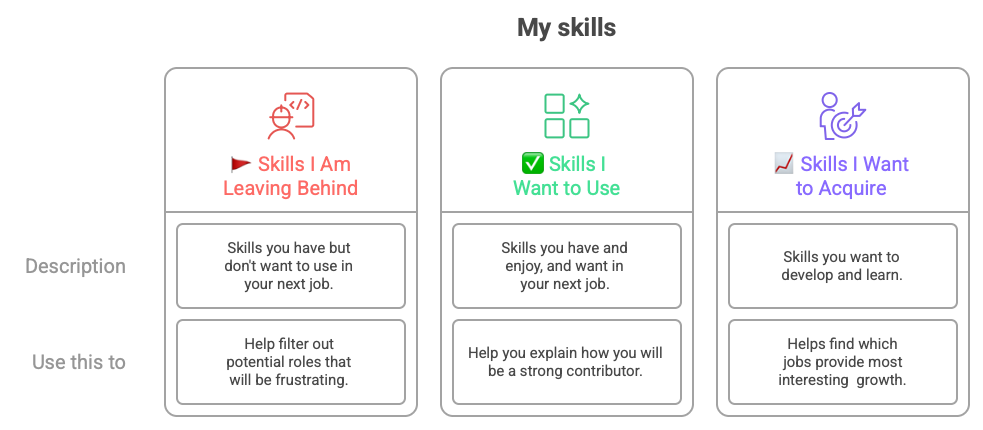
- Start brainstorming into each of those columns. The critical thing here is being honest - this isn’t for anyone else to see, so your only audience is yourself. Don’t write what society, or your colleagues, or your boss, or your parents told you should write. Don’t write what you think the “right” answer is. Write what your heart and mind tell you is true for you. In all the years I’ve been encouraging others to do this exercise, nobody has ever shown me their answers to these questions — and that’s totally okay.
- Carry it around for a few days (or a photo of it, if you don’t want to carry the paper itself), and add things as they occur to you. Very often, you’ll get the first 80% out in a burst of activity, and then your subconscious will keep thinking about it - make sure you can capture those thoughts as they appear.
- Once you’re done, you’ll have something that can help you navigate toward what you want, and away from the things that are going to drain you.
Reducing the search space — Crossing off what you don’t want
Many years ago, I read The Now Habit by Neil Fiore, a book about understanding what drives the difficulty some people feel about starting tasks and recommending some tactics for reducing that difficulty. One of the core tactics is The “Unschedule” - essentially, putting all the non-work things that you need to do (including rest!) into your calendar, as a way of visualising how much time you don’t have available, to help you create the feeling of time pressure sooner and therefore get started earlier.
You can take a similar approach to working out what jobs you might be interested in. It’s okay if you don’t even know what roles exist — this exercise will help you to get a sense of the landscape.
- Grab the biggest list of relevant jobs that you can find – if you work for a big company and they have a standardised list of job titles/roles, that’s a great option; else, look at an industry framework like SFIA for IT, SFIA for Cyber. If you’re not in tech, look for your industry’s equivalent.
- Cross off every job you definitely don’t want. Be ruthless. Again, this is for you and nobody else ever needs to know. You’re not making value judgements about the people who are in those roles, you’re just trying to work out what’s right for you.
- Of the jobs you haven’t crossed off, circle the groups that are most interesting to you - with a particular focus on those you know least about. What are the questions you would ask the people who are experienced experts in those jobs? Would you want to know what the work involves day-to-day? Or which skills are most important? Or how they developed their personal credibility for the role?
Reducing the uncertainty - Talk to people
Once you’ve got a list of interesting roles and questions you want to ask, there’s one more step: go find friendly people in those roles, ask those questions and make friends.
Finding people can be a bit varied. Again, if you have the benefit of working somewhere large, you can often just look them up in your internal directory and reach out.
Many people are really quite happy to talk about their roles – particularly what they find most interesting about it, how they got into it, what they’ve learned. So, you should assume that it’s probably safe to gently ask, maybe something like “I’m really interested in moving into a role in your field, but I don’t know a lot about it - what do you find most interesting about your work?”, and go from there. If you show them genuine curiosity and ask the follow-on questions, it’s not unusual for the conversation to run for a while. And if they don’t want to talk about it, that’s fine - just gently move on to the next person when you can, and try again.
Otherwise, industry associations and interest groups can be great sources for this kind of thing - anything that runs meetings or gatherings of people. Helpfully, the kind of people that will go to a gathering tend to be extroverts (or outgoing introverts4) that are going to those meetings to talk, so you don’t have to wonder about whether they want to talk.
(If you (like me) are in that introvert group, then I know cold outreach can feel impossible - often grounded in concern that you might be bothering the other person. Often though, people are not bothered by a question about their work from someone genuinely interested, and they can be delighted to chat. So, please experiment with asking.)
Final thought
A few years ago, I was on an internal leadership development course at my organisation where we heard from most of the EVPs about their career journeys. I was really struck that none of them said they had a specific plan for their careers, given how ubiquitous that career advice is; instead, they consistently said that they had navigated by their principles (of various kinds), and that they had reached very senior executive roles. One said “I know how I want to contribute and I know what I’m good at, and I look for my next role to match that” (approximately).
That was helpful for me in two ways. It gave me permission to not have a plan, and to put down the guilt I had felt about not having a clear idea of what I wanted. And more importantly, it prompted me to focus on creating clarity around how I want to contribute, what my principles are, and to sharpen what I’m good at. That’s served me well since.
(Of course, these are the people who made it, so take it with appropriate salt. This isn’t proof that you will be successful if you don’t have a plan; just proof that you don’t necessarily have to have a plan to be successful.)
So, if you’re at a bit of a career crossroads, you’re not alone. It’s a normal part of working life. Hopefully, those tactics will be useful to you in collecting some information and in focusing your search for what you might choose to do next. Best of luck!
-
And one of the things I’ve learned along the way is that (approximately) nobody feels like their career is fully under control. ↩
-
You can do this on a computer if you want to, but it seems to work much better on paper, particularly in the initial drafting phase. ↩
-
I often tell the story from early in my career where I was asked to create an updated system diagram - the company had a printout of the old one, but nobody could find the Visio file - so I sat in a meeting room for a couple of hours while a dozen people each explained their bit of the system and how it all connected; I tended to be more cautious about admitting I could use Visio after that. ↩
-
For those that don’t know me personally, some context: I’m an introvert, I have anxiety, and I find events with lots of people daunting. And: I really enjoy connecting with people individually, and my job often requires me to go to those kinds of events - where I often find that I get chances to have really interesting conversations. So, I am in that “outgoing introvert” - I can find great joy in those conversations, and I ~always need recovery time afterward. ↩